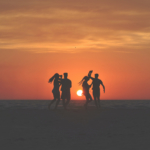
When you move in circles, you can’t take sides.
This is a saying I came up with when teaching dance in Israel during the Second Intifada. In a circle, no one is in front, no one is behind, and all are seen and heard – if they choose to be in the circle. A life lesson, I thought. Dance has always taught me life lessons – how to lean on people, where to lift people up, and as a popular TV show highlighted, when in need, “dance it out.”
When you move in circles, you can’t take sides. I learned, also during the Second Intifada, that not everyone agreed. “You have to take a side,” I was told. Side-ism, it seems, is also popular. Since October 7, there was October 8 – where sides in the not-Middle-Eastern-sand were drawn, and you had to choose. Being pro-Palestinian moved quickly into that Israel had no right to exist, and being pro-Israel moved into defending that right, to borrow a phrase from the other “side,” by any means necessary. Being pro-both peoples was, and somehow still is, seen as “normalization.” Although I see that this sentiment can come from being fed up with what is and has been, if it was normal to have both peoples live and love together, we wouldn’t be where we are today.
During the time from 2005 to today, 2025, I’ve leaned into the various sides I have had the privilege of meeting through my dance and arts life – the coexistence arts groups that still met, dodging bombs, to create together while the dialogue groups stopped, visionaries of peace through arts and ritual in and outside the Green Line, hardline anti-normalization West Bank artists in refugee camps, deeply spiritual as well as peaceful dancing religious settlers, and welcoming Druze, Syrian and Lebanese Christian, Bedouin as well as Muslim Palestinian Israelis, artists and non-artists.
In the arts groups that continued during the Second Intifada, included was a capoeira class for Palestinian and Jewish Israeli teens taught be a Brazilian Jew, a circus directed by an Israeli Jew and Palestinian, and a film-making group whose director said, “if you’re fighting over camera angles, you can’t fight over land.” I also interviewed the Palestinian and Jewish Israeli actors, Jewish-American director and Palestinian writer for a play that was performed in both Israel and the US that highlighted a theme of birth along with the usual whose land is it theme. During rehearsals, the actors began real fights with each other over the land and the play wasn’t looking like it was going to continue. Then the director focused on the birth theme, and the actors were instructed by a mid-wife how to simulate the seven cardinal movements of birthing with each other, in Palestinian/Jewish Israeli pairs. This birthing theme, or rather re-birthing, saved the play. I don’t think everyone was best friends afterwards, but the play continued, making people deal with each other and the other’s needs. Another life lesson.
During this time, I met Dorit Bat Shalom. She has been a visionary ritualist and theater artist for over 50 years. At that time, I helped direct (a bit) a play she was working on with Iptisam Mahammad, a Palestinian who lives in Fureidies (Paradise, Israel) whose story of coming-to-radical-coexistence resembles that of Rosa Parks.
Fast forward to 2024. A year and a half into the awful atrocities on and following October 7, Dorit and I reached out to each other, and I learned of Women of Vision, a growing group of women and nonprofit leaders of all genders who meet regularly and have become even more defiantly co-existence, pro-peace, and pro-shared society than ever before. In September, 2024, I brought four of these women, two Palestinian and two Jewish Israeli, to the Northeast US to share their stories, art, ritual and lives. A few amazing humans, including Rabbah Riqi Kosofske, Rabbi Amita Jarmon, and Madeleine Charney, and local organizations helped with this endeavor. I did this because I couldn’t take the side-ism, and the war on words that was created by that side-ism in what seemed like all parts of the world.
After this tour, a group of people who care about humanity, about both/and, and who prefer circles to sides gathered. Some are members of Friends of Standing Together, Americans who are listening to the Arabs and Jewish Israelis who believe that no one is going anywhere, and we must work together for the benefit of all. This both/and group, or the Friends of Women of Vision, working with Dorit Bat Shalom, created a tour to Israel and Palestine, inside and outside the Green Line, to meet the extraordinary, ordinary people who are working towards peace and coexistence, especially at this time. Even at this time, and because of this time.
I am beginning to write about those people, the groups they belong to, and what they, as visionaries out of necessity, stand for. This is the first in a series about them, and the fierce bravery and dedication they live every day.
In the first evening, following several meetings, a group formed a circle at Dorit’s home. In that circle was our Palestinian guide and a woman whose parents were both brutally murdered in their home on October 7, 2023, by Hamas. The two of them found each other and hugged and talked. We in the West don’t witness this enough – that people want to work towards true coexistence and peace. I will attempt to share pieces of those amazing people, many of them women, who to me represent the radical middle, a place where the slogans of extremism are not welcomed, and where dignity, honor and empathy reign.
The best example of this on that night was stated in a spoken word poem by Ellaya Ayal Mor, accompanied by Shira Golan. I hope you can hear the meaning – Stand for Peace. https://youtu.be/u5CLq_z6aDg